The difference between an appetite tincture vs digestive bitters often comes from positioning, flavor, and directions rather than a fixed product standard. Both categories can contain bitter roots, aromatic seeds, warming spices, and dandelion preparations. This guide shows you how to compare them using facts from the label.
HerbEra approaches this comparison as a label-reading task. The product name can introduce the formula, but botanical identity, plant parts, serving information, and extraction details provide the useful evidence.
Are Appetite Tinctures and Digestive Bitters Separate Categories?
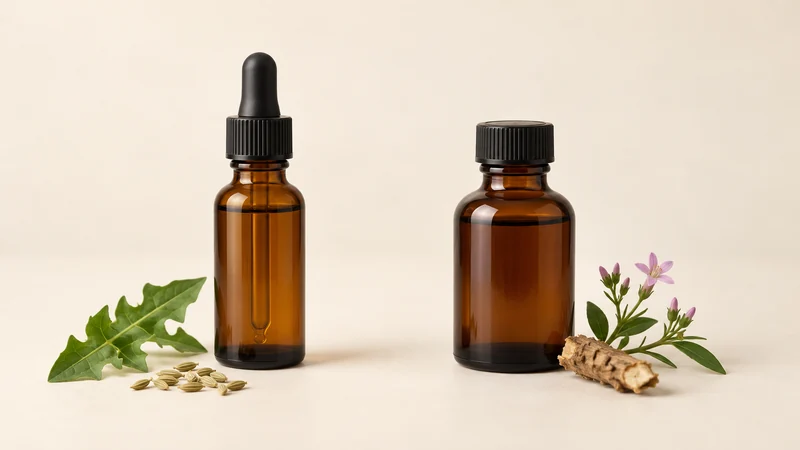
They are separate marketing categories, but their formulas can overlap substantially. Appetite tincture usually describes a liquid herbal blend positioned around normal appetite and meal routines. Digestive bitters usually describes a formula built around a noticeable bitter taste.
Neither name requires a specific ingredient, serving size, or extraction method. Two products can contain similar herbs while using different names. One product can also fit both descriptions.
Comparison point | Appetite tincture | Digestive bitters |
|---|---|---|
Primary positioning | Normal appetite and meal routine | Bitter flavor and digestive wellness routine |
Standardized formula | No universal standard | No universal standard |
Typical format | Liquid herbal extract with a dropper | Drops, spray, or liquid bitters bottle |
Formula structure | Single botanical or multi-herb blend | Often a blend, but single-herb products also exist |
Expected taste | Bitter, aromatic, warming, or mildly sweet | Usually noticeably bitter |
Common liquid medium | Glycerin, water, alcohol, or a combination | Alcohol, glycerin, water, vinegar, or a combination |
Common label directions | Often connected with meals | Often connected with meals |
What the name confirms | The intended product position | Bitterness is central to the product concept |
What the name does not confirm | Exact composition, strength, or personal suitability | Exact composition, strength, or personal suitability |
What Does Appetite Tincture Mean?
Appetite tincture is usually a descriptive name for a liquid supplement positioned around normal appetite or preparation for meals. It is not a formally standardized herbal formula.
The formula may combine strongly bitter roots with aromatic seeds and warming ingredients. Other products may use a simpler ingredient list. The category name does not tell you which botanicals are present or how much the serving contains.
Product positioning
The words on the front label tell you how the manufacturer presents the product. They do not replace the Supplement Facts panel, ingredient list, or directions.
Statement of identity
In the United States, a dietary supplement must carry an appropriate statement of identity. A descriptive product name does not replace the need to identify the item as a dietary supplement, herbal supplement, or another permitted type.
Formula variation
One appetite tincture may use gentian and centaury for a strongly bitter profile. Another may place more emphasis on fennel, cayenne, or other aromatic ingredients. Shoppers should not assume that products sharing the same category name are equivalent.
What Are Digestive Bitters?
Digestive bitters are liquid products designed around bitter-tasting botanical ingredients. The category describes a sensory and marketing format rather than one regulated recipe.
Some bitters contain several roots, leaves, peels, and spices. Others use only one or two botanicals. Glycerin, citrus flavors, or sweeteners may soften the bitterness.
Bitter flavor
A bitter taste shows that bitter compounds are perceptible at the used serving. It does not verify botanical identity, extract concentration, purity, or finished-product quality.
Flexible ingredient selection
There is no ingredient that every digestive bitters product must contain. Manufacturers select botanicals based on flavor, traditional formulation, availability, and product positioning.
Variable serving directions
Serving size and timing differ between formulas. Use the directions on the specific bottle rather than applying instructions from another bitters product.
Which Ingredients Are in the Appetite Tincture Formula?
The formula discussed here contains eight botanical ingredients. Dandelion root and dandelion leaf count separately because they are distinct plant parts with separate label entries.
Ingredient | Botanical name to confirm | Plant part listed | Label detail to verify |
|---|---|---|---|
Gentian | Gentiana lutea | Root | Confirm the species, extraction format, and amount in the blend |
Burdock | Arctium lappa | Root | Confirm the species and quantity of root extract |
Fennel | Foeniculum vulgare | Fruit, commonly called seed | Confirm the species and whether the ingredient is whole fruit or an extract |
Dandelion | Taraxacum officinale | Root | Confirm the preparation and individual quantity |
Centaury | Centaurium erythraea | Aerial herb | Confirm the species and the manufacturer's definition of herb |
Dandelion | Taraxacum officinale | Leaf | Confirm the preparation and individual quantity |
Cayenne pepper | Capsicum annuum or Capsicum frutescens | Fruit | Confirm the exact Capsicum species and preparation |
Blessed thistle | Centaurea benedicta, synonym Cnicus benedictus | Leaf | Confirm the accepted botanical name and whether leaf alone is used |
How Should You Compare the Ingredient Lists?
Compare species, plant parts, preparation types, quantities, and other ingredients. Do not rank two products from the number of herbs or the category name alone.
HerbEra's editorial standard for an eight-herb appetite tincture blend is that every botanical should be identifiable by its common name, botanical identity, plant part, and place within the formula. The serving amount and liquid medium should also be clear.
Botanical identity
Look for a complete Latin binomial when available. Common names can vary between regions and may refer to more than one species.
Plant part
Root, leaf, fruit, and aerial herb are distinct botanical materials. Dandelion root and dandelion leaf should remain separate when both occur in a formula.
Preparation type
Determine whether the formula uses raw plant material, individual liquid extracts, or one combined extraction. These approaches are not interchangeable descriptions.
Individual quantities
A fully disclosed formula lists the quantity of every ingredient. A proprietary blend may list only the total blend amount, which limits direct comparisons between products.
Other ingredients
Review glycerin, water, alcohol, flavors, sweeteners, and preservatives. These components affect taste, viscosity, and format even though they are not the featured botanicals.
Which Ingredients Create the Bitter Profile?
Gentian root and centaury herb are the clearest bitter components in this formula. Dandelion root and blessed thistle can also contribute bitterness. Fennel and cayenne add different sensory notes.
Burdock root has a milder earthy profile. Fennel fruit is aromatic and slightly sweet. Cayenne contributes heat rather than traditional bitterness. Combining these sensory groups creates a more complex tincture than a formula based only on bitter roots.
Taste still does not establish concentration. A small quantity of an intensely bitter ingredient may dominate the flavor, while a larger quantity of a mild ingredient may be less noticeable.
Why Are Dandelion Root and Leaf Listed Separately?
Dandelion root and leaf are separate ingredients because they come from different plant tissues. They should not be combined into one row when the formula identifies both parts.
The two materials differ in structure and chemical composition. Their individual presence does not reveal the proportion used in the blend. If the label gives only a combined proprietary blend amount, the quantity of each dandelion part may remain unknown.
When comparing products, check whether another formula uses root, leaf, or both. A label stating dandelion without a plant part provides less precise information.
Does the Extract Ratio Show Which Product Is Stronger?
No. An extract ratio describes part of the manufacturing process. It does not independently establish greater strength, quality, or suitability.
To interpret a ratio, you need to know:
Whether the starting herbs were fresh or dried
Whether the ratio applies to the whole blend or individual ingredients
Which extraction medium was used
How much finished extract appears in one serving
Whether the stated ratio is herb-to-solvent or herb-to-extract
Whether the product lists an herb-equivalent amount
A formula with more concentrated manufacturing numbers may provide a smaller serving. Another product may use a larger serving of a less concentrated preparation. Compare the complete label rather than one ratio.
Does Alcohol-Free Mean Glycerin-Based?
Not always. Many alcohol-free liquid extracts use glycerin and water, but alcohol-free can also refer to products using water, vinegar, or another suitable medium.
Glycerin tastes sweet and creates a thicker liquid. It can soften the perceived bitterness of gentian, centaury, and dandelion root. Alcohol-based extracts usually have a thinner texture and sharper flavor.
These format differences do not establish that one option is universally superior. A useful comparison requires matched ingredients, servings, extraction specifications, and finished-product testing.
Do Serving Directions Separate the Categories?
No. Serving directions may show how a manufacturer positions a formula, but they do not define a separate product category.
Compare whether the serving is stated in drops, dropperfuls, milliliters, teaspoons, or sprays. Drop size varies with liquid viscosity, bottle angle, temperature, and dropper design. Milliliters offer a more consistent comparison.
Review the maximum labeled daily serving as well as the single serving. Two bottles can use similar ingredients but provide different total daily amounts.
What Safety Details Should You Check?
Review every ingredient because formula-specific cautions matter more than the product category. A multi-herb tincture requires consideration of the complete blend.
Check pregnancy and breastfeeding guidance, age restrictions, botanical allergies, medication considerations, and the presence of alcohol or other carriers. Blessed thistle and dandelion belong to the Asteraceae family, which may be relevant for people with sensitivities to plants in that family.
Cayenne may create a noticeable warming sensation. Gentian and centaury contribute pronounced bitterness. Individual tolerance varies, so follow the product directions and avoid transferring serving instructions from another formula.
Seek qualified guidance if you use medication, have a health condition, are pregnant or breastfeeding, or are considering a product for a child.
Checklist for Comparing Appetite Tinctures and Digestive Bitters
Use this checklist to compare the formulas behind the product names. Focus on details you can verify directly from the label or manufacturer documentation.
Confirm the product identity
Check whether the product is identified as a dietary supplement, herbal supplement, food product, or another regulated type.
Count the ingredients correctly
Count separately listed plant parts as separate formula entries. Dandelion root and dandelion leaf are two ingredients.
Verify botanical names
Look for complete scientific names. Ask the manufacturer when the product page lists only common names.
Check every plant part
Confirm root, leaf, fruit, or aerial herb for each botanical. Avoid assuming that different plant parts are interchangeable.
Identify the liquid medium
Review glycerin, water, alcohol, vinegar, and other carriers. Do not infer the medium from the word tincture alone.
Compare serving amounts
Use milliliters where possible. Compare both the amount per serving and the maximum labeled daily amount.
Review blend transparency
Determine whether individual quantities are shown or only a combined proprietary blend total appears.
Read every warning
Consider age, pregnancy, allergies, medication use, and personal health circumstances.
FAQ
Is an appetite tincture the same as digestive bitters?
It can be. The formulas may overlap even when the labels use different product positions.
Is appetite tincture a standardized category?
No. The name does not require a specific ingredient list, extraction medium, or serving size.
How many ingredients are in the formula discussed here?
There are eight ingredients because dandelion root and dandelion leaf appear as separate entries.
Which ingredients provide the strongest bitter profile?
Gentian root and centaury herb are the most clearly bitter ingredients in this formula.
Does the formula contain artichoke or ginger?
No. Neither artichoke nor ginger appears in the eight-ingredient formula discussed here.
Are alcohol-free tinctures always glycerites?
No. They may use glycerin, water, vinegar, or another non-alcoholic liquid medium.
Does a more bitter taste mean a more concentrated formula?
No. Ingredient selection, serving size, carriers, and individual taste sensitivity can change perceived bitterness.
What should shoppers compare first?
Start with botanical species, plant parts, formula quantities, liquid medium, serving size, directions, and warnings.
Glossary
Appetite tincture
A liquid herbal product positioned around normal appetite and meal routines.
Digestive bitters
A product category built around bitter-tasting botanical ingredients.
Botanical name
The scientific genus and species used to identify a plant precisely.
Plant part
The botanical tissue used, such as root, leaf, fruit, or aerial herb.
Tincture
A liquid herbal extraction format traditionally associated with alcohol and water, though commercial usage varies.
Glycerite
A liquid herbal preparation that uses glycerin as a major carrier or extraction ingredient.
Extract ratio
A manufacturing expression relating starting botanical material to extraction liquid or finished extract.
Proprietary blend
A combination that lists a total quantity without necessarily disclosing every individual ingredient amount.
Aerial herb
The above-ground herbaceous material, which may include leaves, stems, and flowering portions.
Conclusion
Appetite tinctures and digestive bitters often overlap in format and bitter ingredients, but the product names do not define fixed formulas. Compare all eight botanical entries, their plant parts, liquid medium, serving information, and warnings before choosing.
Sources Used
FDA guidance on dietary supplement identity statements - fda.gov/food/dietary-supplements-guidance-documents-regulatory-information/dietary-supplement-labeling-guide-chapter-ii-identity-statement
European Union herbal information for Gentiana lutea L., radix - ema.europa.eu/en/medicines/herbal/gentianae-radix
FDA guidance on declaring botanical ingredients and plant parts - fda.gov/food/dietary-supplements-guidance-documents-regulatory-information/dietary-supplement-labeling-guide-chapter-iv-nutrition-labeling
FDA guidance on dietary supplement label statements - fda.gov/food/dietary-supplements-guidance-documents-regulatory-information/dietary-supplement-labeling-guide-chapter-vi-claims